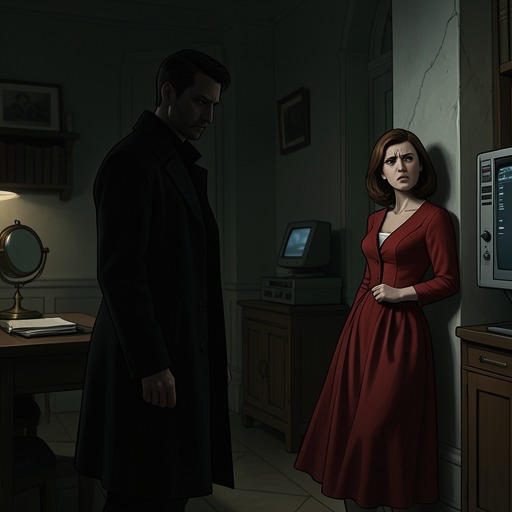
Michael visits Struthof concentration camp
The ReaderMichael Berg’s visit to Struthof is an attempt to make the history of the concentration camps real enough to confront. He travels because the trial has left him with questions and because the images he already carries seem inadequate; but the visit does not deliver the understanding he seeks. The camp’s material traces, his failure to imagine the suffering they contained, and his conflict over Hanna Schmitz’s crime reveal the distance between looking at a historical site and comprehending what happened there.
Purpose and Journey
After deciding to leave, Michael considers going to Auschwitz, but obtaining a visa would take weeks. He instead chooses Struthof in Alsace, the nearest concentration camp, which he has never seen. He hopes that reality will displace the clichés formed from the few images and survivor testimonies available to him. His purpose is tied directly to the trial and to his recognition that he lacks firsthand knowledge.
Michael hitchhikes to the site. Among his rides are a truck driver who drinks bottle after bottle of beer and a Mercedes driver wearing white gloves. After Strasbourg, a driver bound for Schirmeck takes him closer. The landscape on the way is not an abstract approach to history: the road crosses the Vosges, passes vineyards and a gently rising valley, and runs beside a railway line, with forests, quarries, factories, a former sanatorium, and a turreted villa appearing along the slopes.
When Michael tells the driver that he is going to Struthof, the man falls silent in the middle of their conversation. He later asks why Michael is visiting. Michael explains that he has come because of the trial and his lack of direct knowledge. The driver frames the desire to understand terrible acts as a question about motives such as passion, love, hatred, honor, and revenge. Michael nods, but the exchange does not resolve what he is trying to understand. The ride ends in a rupture: the driver stops the car, tells Michael to get out, and drives away. Michael walks the remaining distance, hearing birds, wind in the trees, and a stream before reaching the camp about fifteen minutes later.
The First Visit and Its Failure
The visit is not represented as an arrival at full comprehension. Michael’s stated hope is that seeing the place will drive out the clichés, but the physical site cannot by itself give him a concrete grasp of the camp as a place inhabited by prisoners and guards and filled with suffering. What he encounters sharpens the problem rather than solving it: historical reality is present in the remains, while its human scale resists his imagination.
The driver’s abrupt reaction also interrupts any simple passage from curiosity to knowledge. Michael has explained his purpose, but the conversation turns away from an orderly discussion of history and ends with his being forced out of the car. He must finish the journey on foot. The episode therefore binds the approach to Struthof to a disquieting encounter whose meaning Michael cannot confidently determine; he cannot tell why the driver fell silent, and the narration does not supply an explanation for his departure.
Return to the Site
Michael goes back to Struthof years later, on a clear, cold winter day. Snow covers the wooded surroundings and the camp’s sloping terrace, which opens onto a broad view of the Vosges. The watchtowers, barracks, barbed-wire entrance, sign identifying the site as the Struthof-Natzweiler concentration camp, and double fence remain visible, but the snow conceals the ground between the surviving barracks and the places where others once stood. Under the bright covering, the area can look like a children’s sledding slope, and the barracks like cheerful holiday buildings where children might soon be called inside for cake and hot chocolate. The imagined domestic scene is a sharp contrast to the camp’s function and history.
The site is closed. Walking through the snow, Michael remembers details from his first visit: the steps between the former barracks, the crematorium ovens displayed in another barracks, and cells housed in a separate one. He recalls how deliberately he had tried to reconstruct the camp’s past. He had looked at a barracks, shut his eyes, and imagined row upon row of buildings; used an information booklet to calculate how many people had been crowded into one barracks; and learned that the steps had also served for roll call. Looking upward from the bottom of the camp, he tried to populate those steps with rows of prisoners’ backs.
None of these acts of reconstruction succeeded. Michael remembers the failure as dreadful and shameful: measurement, visual effort, and factual information could not turn the site into a fully imaginable experience of the people who suffered there. His return confirms that the problem was not simply a lack of details. Even an exact awareness of buildings, capacity, and the uses of the steps leaves an unbridgeable gap between the surviving place and the historical lives that occupied it.
On the way back down the hill, Michael notices a small white house across from a restaurant. A sign identifies it as the former gas chamber, yet its doors and sandstone-framed windows make it look as though it could have been a barn, shed, or servants’ quarters. The building is closed, and Michael cannot remember whether he entered it on his first visit. This time he does not get out of the car: he sits briefly with the engine running, looks at the house, and drives on. The pause registers an encounter with a site whose ordinary appearance does not make its function easier to absorb.
Understanding and Condemnation
The visit is inseparable from Michael’s effort to understand Hanna Schmitz’s crime without betraying its victims or Hanna herself. He wants to understand and condemn the crime at once, but experiences the two tasks as pulling against each other. When he tries to understand, he fears he is failing to condemn as fully as the crime demands; when he condemns, understanding seems to have no place. Yet he also feels that refusing to understand Hanna would betray her again. He cannot reconcile these demands, and the text presents no solution that would make either judgment disappear.
That impasse clarifies why Struthof cannot function as a simple source of moral certainty. The camp gives Michael material evidence—barracks, ovens, cells, steps, a marked gas-chamber building—but not a way to convert evidence into complete imaginative possession of the past. Nor does the visit free him from the difficulty of judging Hanna. Its significance lies partly in refusing an easy resolution: Michael’s wish to know more remains bound to the danger that understanding may be mistaken for exoneration, while condemnation alone cannot answer his desire to comprehend the person whose crime he must judge.
Aftermath and Significance
The day after his first visit is beautiful, and hitchhiking back takes only a few hours. Yet Michael experiences the city as strange, as if he has been away for a long time. That estrangement does not mean the world of the camps has come closer. Instead, his impressions of Struthof join the few images he already has of Auschwitz and Bergen-Belsen and freeze alongside them. The trip has changed his immediate perception of the city without giving him the access to historical reality he sought.
Struthof thus marks both an act of inquiry and its limit. Michael goes because secondhand images and inherited clichés seem insufficient, and he returns to examine the site again; still, deliberate looking, calculation, and remembrance cannot reproduce the lived reality of the camp. The journey leaves him with sharper knowledge of what he cannot imagine and with the unresolved obligation to hold understanding and condemnation together. Its failure is not a reason to abandon either task, but it prevents him from treating firsthand sight as if it could settle them.